October 2, 2026
Every rank in Rocket League is a number underneath. You never see it in game, which is why "what MMR is Diamond" is one of the most searched questions about the ranking system, and why most of the answers you find are a season or more out of date.
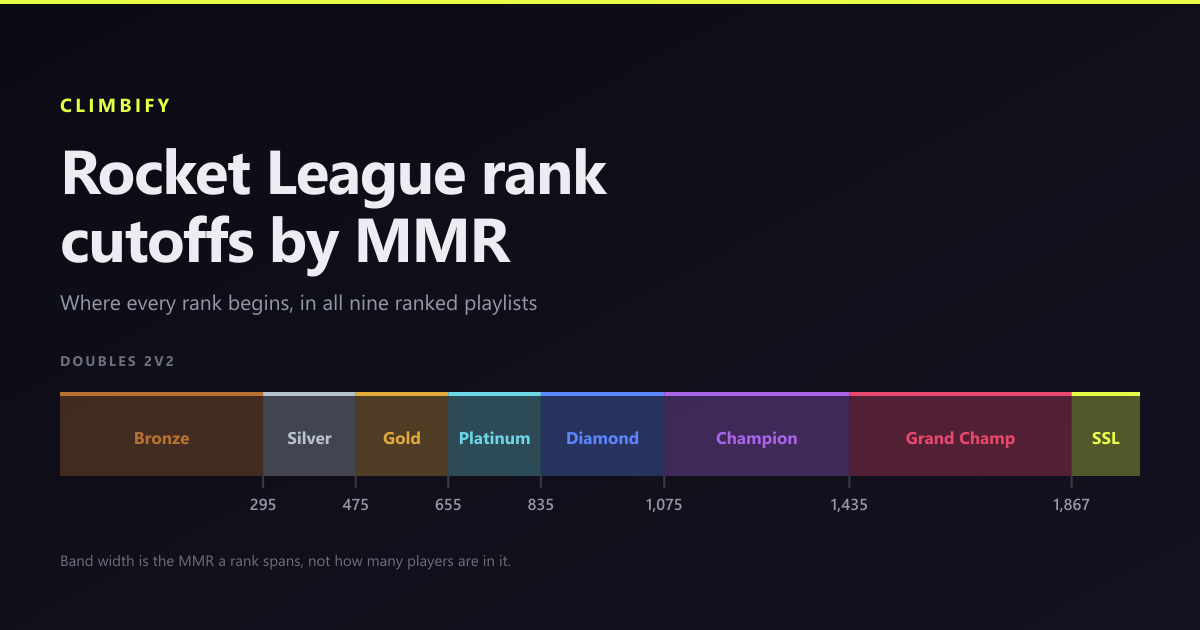
The short version, for Doubles 2v2: Silver starts at 295 MMR, Gold at 475, Platinum at 655, Diamond at 835, Champion at 1,075, Grand Champion at 1,435 and Supersonic Legend at 1,867. Every other playlist runs on its own scale, and the table below has all nine.
This page is maintained by Climbify, where we do Rocket League rank boosting and one to one coaching with Supersonic Legend players. We built the lookup below because our own customers kept asking the same question: here is my MMR, what rank is that, and how far am I from the next one.
Pick a playlist, or type your MMR to find where you sit.
One against one. The smallest MMR numbers on the list, because a solo playlist has no teammates to carry or be carried by.
| Rank | Starts at | Div I | Div II | Div III | Div IV |
|---|---|---|---|---|---|
| Supersonic Legend | 1,353 | 1,353 to 1,469 | – | – | – |
| Grand Champion III | 1,290 | 1,290 to 1,299 | 1,299 to 1,311 | 1,318 to 1,334 | 1,338 to 1,353 |
| Grand Champion II | 1,227 | 1,227 to 1,238 | 1,240 to 1,251 | 1,260 to 1,275 | 1,277 to 1,294 |
| Grand Champion I | 1,163 | 1,163 to 1,178 | 1,181 to 1,197 | 1,198 to 1,209 | 1,217 to 1,232 |
| Champion III | 1,100 | 1,100 to 1,118 | 1,120 to 1,137 | 1,100 to 1,150 | 1,100 to 1,170 |
| Champion II | 1,055 | 1,055 to 1,058 | 1,060 to 1,077 | 1,078 to 1,086 | 1,097 to 1,105 |
| Champion I | 995 | 995 to 998 | 1,000 to 1,014 | 1,018 to 1,033 | 1,037 to 1,051 |
| Diamond III | 935 | 935 to 938 | 940 to 957 | 958 to 975 | 977 to 994 |
| Diamond II | 875 | 875 to 878 | 879 to 897 | 898 to 915 | 917 to 928 |
| Diamond I | 800 | 800 to 818 | 819 to 837 | 800 to 856 | 857 to 874 |
| Platinum III | 740 | 740 to 758 | 740 to 777 | 740 to 796 | 740 to 814 |
| Platinum II | 680 | 680 to 698 | 699 to 717 | 680 to 736 | 737 to 754 |
| Platinum I | 620 | 620 to 638 | 639 to 657 | 658 to 676 | 677 to 694 |
| Gold III | 560 | 560 to 578 | 579 to 597 | 598 to 616 | 617 to 634 |
| Gold II | 500 | 500 to 518 | 519 to 537 | 538 to 556 | 557 to 574 |
| Gold I | 440 | 440 to 458 | 459 to 477 | 478 to 496 | 497 to 514 |
| Silver III | 380 | 380 to 398 | 400 to 417 | 418 to 436 | 437 to 454 |
| Silver II | 320 | 320 to 338 | 340 to 357 | 358 to 375 | 377 to 394 |
| Silver I | 260 | 260 to 278 | 280 to 297 | 298 to 315 | 317 to 334 |
| Bronze III | 200 | 200 to 218 | 222 to 237 | 242 to 255 | 257 to 274 |
| Bronze II | 155 | 155 to 158 | 162 to 177 | 178 to 195 | 197 to 214 |
| Bronze I | -100 | -100 to 113 | 115 to 127 | 132 to 140 | 144 to 152 |
| Unranked | 296 | 296 to 826 | – | – | – |
Observed MMR from tracked players, read from Rocket League Tracker on 2026-10-02. Psyonix has never published the real boundaries, so treat these as close rather than exact, and expect them to move after a season reset.
The column that matters is Starts at. That is the MMR at which a rank begins, and it is the figure to use when somebody asks what you need for Diamond or Champion. The four division columns are the detail inside each rank.
Divisions are not evenly spaced and they are not the same width across playlists. In Doubles 2v2 a full rank spans roughly 120 MMR, so each division is about 30. In Duel 1v1 the whole ladder is compressed into a smaller range, so the same four divisions cover much less ground. That is why climbing a division in 1v1 can feel quicker than in 2v2 even when you are winning at the same rate.
If you are a few hundred short of a rank you want, there are two honest ways to close that gap. Boosting gets you the rank itself, played by a Supersonic Legend on your account or alongside you in a party. Coaching gets you the ability to hold it yourself, which is the one that stops you reading this page again next season.
For Doubles 2v2, the most played playlist, the tier floors are:
Standard 3v3 runs on almost the same scale, so those numbers are a close guide there too. Duel 1v1 and the extra modes are different enough that you need the table.
MMR is a hidden skill rating. Winning raises it, losing lowers it, and the size of each change depends on who you played. Beating a team rated above you moves it more than beating one below you.
Three things about it cause most of the confusion:
It is per playlist. Your 2v2 number and your 3v3 number are separate and can sit a full rank apart. Extra modes have their own, and tournaments have another one again.
Your rank is a label on the number, not the other way round. You do not climb by winning a set quota of games. You climb because the number crossed a line, and the icon updates to match.
You can lose a rank without playing badly. If you stop queueing, nothing happens to your MMR, but the cutoffs themselves shift between seasons as the population moves. Coming back to a lower rank on the same MMR is a real thing.
This is the part worth understanding, because it tells you how much weight to put on any Rocket League rank table you find, including this one.
Psyonix has never published the real boundaries. No rank distribution anywhere is official. Every one of them, ours included, is built by looking at players whose MMR is known and working backwards to where the edges must be.
That has three visible consequences in the table above.
Empty cells. Rumble Bronze I has three of them. Almost nobody tracked is sitting in Bronze I of a mode few people queue, so there is nothing to infer a range from. An empty cell is the honest output. A table that fills those in with a plausible looking number is making it up.
Repeated lower bounds. In 1v1, Platinum III shows 740 for all four divisions. That is not four divisions that genuinely start together. It means there were too few tracked players in that rank to separate them, so the floor of the whole rank gets reported four times.
Ranges that overlap the rank above. A few upper bounds sit higher than the next rank's floor. With a small sample, one player at an unusual MMR moves an entire boundary.
None of that has been smoothed out here. It would be easy to round everything into a tidy ladder, and the result would look more authoritative while being less true. The tier floors have the most data behind them, so those are solid. Treat the division edges as close rather than exact.
Yes. At the start of each season everybody's MMR is compressed toward the middle. High ranked accounts drop further than low ranked ones, which is why Supersonic Legend and Grand Champion look thin for a few weeks until the top of the ladder spreads back out.
So a rank table captured mid season and one captured just after a reset will disagree, and neither is wrong. The capture date sits under the table for exactly that reason. If you are reading this months later, the shape is still right and the edges will have moved.
Duel 1v1 runs on the smallest scale of any playlist. Supersonic Legend starts around 1,350 there, where in Doubles it is near 1,870. Nothing about that means 1v1 is easier. It is a different scale, and comparing your 1v1 MMR to your 2v2 MMR directly tells you nothing at all.
Doubles 2v2 and Standard 3v3 share almost the same scale, which is why those two are worth comparing. If your 3v3 sits well below your 2v2, that is usually rotation and positioning rather than mechanics, since a third player punishes being in the wrong place far more than it punishes a missed touch.
Tournaments scale like 2v2 and 3v3 but move differently, because you play them in bursts and a full run shifts the number more than a single match would.
Extra modes have their own scales entirely, and smaller player pools, so the data at the top of those tables is thinner. Hoops, Dropshot, Snow Day, Rumble and Heatseeker all top out well below Doubles.
Sitting a division short for weeks is usually not a mechanical problem. At every boundary the same three things decide it: whether you commit to challenges you cannot win, whether you rotate back far enough to be useful on the next play, and whether you are still tilted from the previous game.
A coach will watch one of your replays and tell you which of the three it is, which is faster than another fifty games of guessing. If you would rather just have the rank, our boosting calculator prices any climb in about a minute, and the work is done by verified Supersonic Legend players with VPN protection and live tracking.
The MMR ranges on this page are observed data from Rocket League Tracker, read on the date shown under the table. We have transcribed their ranges and not altered them. What Climbify has added is the per playlist lookup, the tier floors pulled out as their own column, and the explanation of which numbers deserve your confidence.
We do not publish the percentage of players in each rank, because that needs a live feed of the whole population and we do not have one. Anybody showing you a live percentage is either running that feed or estimating it. The cutoffs are what we can state accurately, so the cutoffs are what we publish.
A Supersonic Legend can climb it for you, VPN protected and tracked live. Configure your boost in under a minute.
See boosting services ›